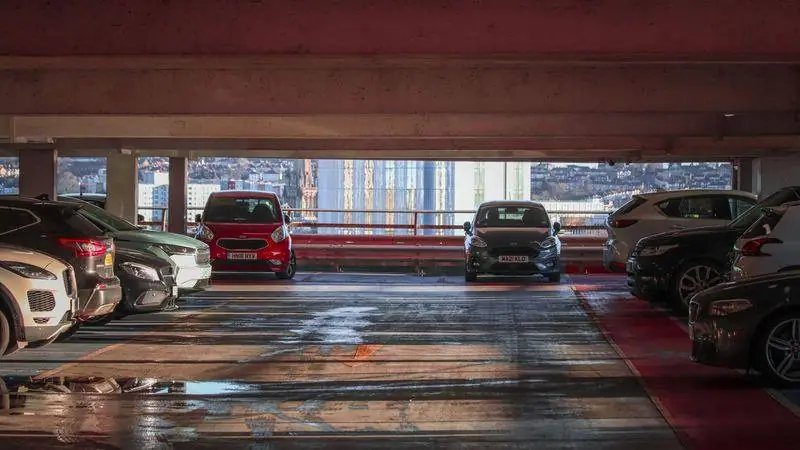


Pearson airport parking is charged by the day, so for a week-long trip the bill grows every night you are away, while a limo or black car is charged per trip. Parking suits short trips and solo drivers; a car service usually wins for a week or longer, for families, in winter and after a long-haul flight home. Downtown Toronto is 27 km, 25–45 minutes from Pearson.
Pearson airport parking vs a limo: what is the real question?
It is not "which is cheaper", because that depends on how long you stay, how many of you travel and where you live. The real question is which costs you less in money, time and effort for this particular trip. Our Pearson airport transportation page covers the airport and the transfer itself. This post is the decision guide for the classic case: a week or more away, with a car sitting in the driveway, and a choice between driving it to YYZ or being driven. We give honest pros for parking too, because for some trips it is the right answer.
How does parking at Pearson work?
Pearson runs several on-airport parking products, and the airport's transportation and parking page lists the current options and rates. In broad terms, Daily Park garages sit beside Terminal 1 and Terminal 3, closest to check-in. Express Park at Terminal 1 is a premium, close-in option. Value Park, further out near Viscount station, is linked to both terminals by the free Terminal Link train. Private off-airport lots with shuttle buses also operate around the airport. Every one of them charges by the day, which is the core of the comparison: the meter, in effect, keeps running for every night you are away.
What should you weigh, side by side?
No price column, because we never publish prices and parking rates change; use the airport's page and our reservation engine for current figures.
| Factor | Driving and parking for a week | Pre-booked limo or black car |
|---|---|---|
| How cost grows | Every day away adds to the bill | Two fixed trips, regardless of nights away |
| Time on departure day | Drive, find a space, walk or ride a train or shuttle | Door to departures curb |
| Time on return | Shuttle or train, find the car, clear snow, drive home | Chauffeur at the pre-arranged pickup area |
| Driving after a long-haul flight | You drive, tired | You are driven |
| Winter | Snow and ice on a car parked for a week | Warm car, winter tires, chauffeur loads bags |
| Party size | Parking cost the same for one or five | Fare split across the party |
| Flexibility if plans change | High, the car is there | High, flights are tracked and bookings move |
| Car left at home | Not applicable | Stays safely in your own driveway |
When is parking honestly the better choice?
Parking makes sense for a short trip, an overnight or two, when you are a solo traveller comfortable driving, you live close to the airport, and the weather is kind. It also suits travellers whose return time is genuinely unknown, though flight tracking takes care of most of that with a booked car. Business travellers who fly out on Monday and back on Tuesday often park and that is reasonable. Someone flying from Terminal 1 and living near Kipling might also find transit simpler than either option. Our post on the cheapest way to get to Pearson ranks those options.
Why does a week change the answer?
Because parking cost is linear in days and a car service is not. Two nights of parking is a small number; seven or ten nights is a large one, and the longer-term lots that are cheaper per day also add time at both ends with trains or shuttles. A pre-booked car costs the same for a trip of three days or three weeks, because you pay for the two rides, not for the days your vehicle sits still. Somewhere between a long weekend and a full week, for most GTA households, the lines cross. Your own number depends on your address, your vehicle class and the parking product you would choose; the reservation engine shows the round-trip fare in a minute, so you can compare with the parking figure on the airport's site.
How much time does parking really take?
More than the drive. On departure day, add the time to enter the garage, find a space on a busy morning, unload bags and walk or ride the Terminal Link or a shuttle to the right terminal. On return, add the walk or ride back, finding the car, loading it, paying at the exit and joining the 427 at the same moment as every other arriving passenger. For Value Park or an off-airport lot, those minutes can add up to half an hour or more at each end. With a pre-booked car, the chauffeur loads the bags at your door and unloads them at the departures curb.

What about winter?
A week in January is where parking loses most people, and a glance at Environment Canada's forecast for your return date often settles it. A car left in an open lot through a snowfall needs digging out, scraping and warming up before you can leave, after a long flight, often in the dark. A garage avoids the snow but not the cold walk or the return-day queues. Our cars run winter tires from November to April, and the chauffeur arrives warm, loads the bags and drives home on roads checked against Ontario 511 before setting off. Winter departures are also when early-morning road conditions are hardest to predict, and a professional driver who does this every day is a calmer bet.
Is driving home after a long-haul flight a safety issue?
It can be. After an overnight flight from Europe or a 14-hour flight from Asia, many travellers are short on sleep and out of sync with the clock. Driving the 401 at rush hour in that state is not ideal. This is the most underrated argument for being driven home: you sit in the back, call the family, and the chauffeur handles the traffic. For a couple or a family, it also means nobody has to be the designated driver after the holiday. Our post on international arrivals pickups explains how the waiting time covers customs and bags.
How does party size change the comparison?
Parking costs the same whether one person or five got out of the car. A car service fare is per vehicle, so it divides across everyone. A couple sharing a business sedan, or a family of five in an SUV, shares one fare each way. Friends flying together can share a Sprinter. Families with young children also skip the struggle of getting car seats, strollers and luggage from a remote lot onto a shuttle: seats are available at booking and installed before the chauffeur arrives at your door.
What mistakes do week-away travellers make?
- Comparing one day of parking with a one-way fare, instead of the whole week with both legs.
- Forgetting that the cheaper long-term lots add a train or shuttle at both ends.
- Assuming a garage space will be free on a March Break or holiday-weekend morning.
- Leaving the return pickup unbooked "to see how we feel", then queueing at midnight.
- Booking a sedan for a family of four with checked bags; an SUV is the right size.
- Not giving the return flight number, so the pickup cannot follow a delay.
Fix these, and whichever option you choose will work as planned.
Where you live matters
Distance changes both sides. A household in Etobicoke, about 12 km and 15 to 25 minutes from Pearson, has a short trip either way. A household in Markham, about 40 km and 35 to 50 minutes, or Oakville, about 30 km and 25 to 40 minutes, faces a longer drive, and a longer one-way fare too. Downtown condo owners often have no spare parking at home and an expensive commute to the airport, which makes being driven especially attractive. Our trip planner gives the distance and drive time from your address, and the engine turns it into a fixed fare.
What about leaving the car at home for a week?
Your car stays in your own driveway or condo garage, where your insurance and security already apply, rather than in a public lot for a week. That is not a reason on its own, but it removes a small worry while you are away. It also means the car is ready at home if someone in the family needs it while you travel, or if plans change and a relative uses it. For downtown residents with one parking spot, being driven to the airport frees it for a partner who stays behind.
Can a car service handle a changed return flight?
Yes. You give the return flight number when you book, and dispatch tracks it. If the airline moves you to an earlier or later flight, message us with the new details and the pickup moves. Included waiting on arrival is 30 minutes for Canadian domestic and US flights and 60 minutes for other international arrivals, from actual landing. Our cancellation policy is measured from the scheduled pickup: free more than 72 hours ahead, 10 % at 72 hours or less, 50 % at 48 hours or less and 100 % at 24 hours or less or a no-show. Our sibling post on round-trip car service vs parking covers booking both legs.
Is an hourly chauffeur ever part of this?
Sometimes, on the return. A traveller landing at 10 a.m. who needs to drop bags at home, stop at the office and see a client before dinner can book the hourly chauffeur service from the arrivals curb instead of a one-way transfer: three hours minimum for sedans and SUVs, extra time in 30-minute blocks, with the same car all day. Parking cannot do that. If your trip itself still needs planning, our travel desk can book flights, hotels and packages alongside the car.
How to compare for your own trip, step by step
- Note your nights away, your terminal and which parking product you would choose.
- Look up that product's current daily rate on the airport's parking page and multiply by the nights.
- Add the time cost of the train or shuttle at both ends and the fuel for two drives.
- Open /book/, enter both legs with flight numbers and see the fixed round-trip fare.
- Divide each total by the number of travellers, then decide.
Our how our fares work page explains what the fare includes and what changes it.