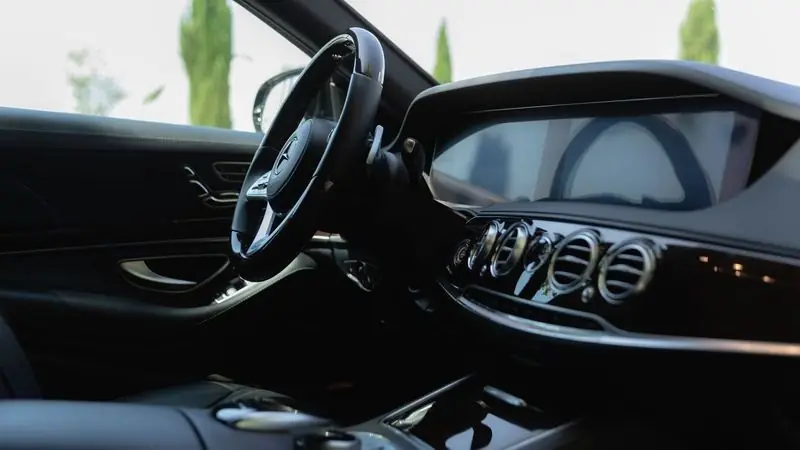


Executive transportation in Toronto should mean a late-model, unbranded car, a licensed and briefed chauffeur, flight tracking, a fixed fare agreed before the trip, discreet conduct, and clean paperwork for every ride. For days with several meetings, the standard is one car and one chauffeur kept by the hour, from a 3-hour minimum, rather than a string of separate rides.
Companies usually discover their executive transportation standard the hard way: a car that arrives with a dented door, a driver who takes a personal call on speaker, an invoice that does not match the booking. This post sets out the standard worth insisting on, written from the dispatch desk's side, so you can measure any supplier against it, including us. If you already know what you want and need an account, our corporate car service accounts in Toronto page explains billing, profiles and set-up.
Executive transportation in Toronto: what is the baseline standard?
The baseline has six parts, and a supplier should meet all six on an ordinary Tuesday, not only on the day the CEO travels.
- The vehicle is late-model, clean, unbranded and the class you booked.
- The chauffeur is licensed, briefed on the passenger and the route, and dressed for business.
- Timing is planned from real traffic, with the car on site before the pickup time.
- The fare is fixed and shown before confirmation, with no meter and no surge.
- Conduct is discreet: no small talk unless invited, no phone calls, no repeating what was overheard.
- Paperwork arrives with the traveller, route, date and reference on every line.
The rest is detail.
What should the car itself look like when it arrives?
It should look like nobody has used it today. Executive work means a washed exterior even in February, a clear interior with no air freshener smell, bottled water within reach and a charging cable for both common phone connectors. The class matters too: a first-class sedan such as the Mercedes S-Class is the usual choice for one senior passenger who works in the back seat, while a premier luxury SUV suits two or three people with luggage or a winter day on the 401.
Ask whether the supplier sends the class you booked or "similar". Similar is how a client ends up in a car that cannot take two suitcases. Our reservation engine books by class, and the fleet page lists the seats and bag counts for each one.
What should a professional chauffeur know before pickup?
More than the address. A briefed chauffeur knows the passenger's name and how they prefer to be addressed, the flight number and terminal, the first meeting and its entrance, whether there is a second stop, and what happens if the flight is diverted. They have checked Ontario 511 for closures on the Gardiner, the 427 and the DVP, and they know which towers on King and Bay have a usable drive-in and which need a quick set-down on the street.
In Toronto, limousine drivers and companies are licensed by the City under its vehicle-for-hire rules. Licensing is the floor, not the standard. The standard is the briefing, and you can test it by asking the dispatcher a simple question the day before: "What happens if the meeting runs 40 minutes over?"
How early should an executive car arrive?
For a home or hotel pickup, the car should be in position 10 to 15 minutes before the booked time, so the passenger walks out to a waiting vehicle rather than watching for headlights. For an airport arrival, punctuality means the chauffeur is timed to the actual landing, using flight tracking, not the schedule printed on the itinerary.
Included waiting at Pearson starts from touchdown: 30 minutes for Canadian domestic and US flights and 60 minutes for other international arrivals, then 15-minute blocks. Other pickups include 15 minutes. If a supplier cannot tell you their waiting rules in one sentence, assume they will surprise you on the invoice.
Where does the chauffeur meet an executive at Pearson?
The fare includes curbside pickup at the terminal's pre-arranged pickup area on the arrivals level, which Toronto Pearson describes on its pre-arranged services page. The passenger tells the pickup-area dispatcher they are meeting a pre-arranged car, and the chauffeur is already nearby. Meet and greet inside arrivals with a name board is an optional add-on, available at booking.
For a first visit to Canada, a guest who does not speak English, or a VIP who should not stand on a curb in January, the meet and greet is worth adding. For a frequent traveller who knows Terminal 1 and Terminal 3, curbside is faster. Our Pearson terminal pickup guide explains the walk from customs to the curb.
Which comparison should a travel manager actually make?
Executive cars compete with other ways of moving people, and an honest standard admits when another option is better.
| Option | Best for | Waiting between stops | Vehicle you get | Paperwork |
|---|---|---|---|---|
| UP Express, Pearson T1 to Union | Solo traveller, carry-on, staying near Union | Not applicable | Train, about 28 min | Ticket receipt |
| Taxi from the rank | Unplanned short hops | Meter runs while waiting | Whatever is next in line | Paper or card receipt |
| Ride-hail app | Quick one-way trips off-peak | New request each time | Varies by driver | App receipt per ride |
| One-way executive car | A planned transfer with luggage | 15 to 60 min included, then blocks | The class you booked | Line on the account invoice |
| Hourly executive chauffeur | A day of meetings, roadshows, dinners | Car waits nearby all day | Same car, same chauffeur | One line per day with stops |
The UP Express is genuinely the simplest choice for one person with a roll-aboard going from Terminal 1 to Union Station. A car wins for Terminal 3, for groups, for heavy bags, and for anyone whose day does not end at Union.
When does an hourly chauffeur become the executive standard?
When the day has more than two stops. A typical Bay Street day might be a hotel pickup at 7:45, a breakfast meeting, two office visits, lunch in Yorkville, a site visit in Mississauga and a 6 p.m. flight. Booked as one-way rides, that is six requests, six waits and six chances for something to slip. Booked through our hourly chauffeur service in Toronto, it is one car and one chauffeur from a 3-hour minimum, with extra time in 30-minute blocks.
The hidden value is the waiting. Between meetings the car becomes the executive's office: a call, a document, a change of plan sent to the chauffeur by text. Nobody stands on a curb refreshing an app.

What does discretion mean in practice?
Discretion is a set of habits, not a promise in a brochure. The chauffeur does not start conversations; answers questions briefly; keeps the radio off unless asked; never takes calls on speaker; never photographs passengers, documents or addresses; and does not discuss one client's movements with another. Name boards can carry a company name or a code word instead of the passenger's name on request.
For sensitive visits, the plan itself is discreet: alternative pickup points away from the main lobby, a car that waits around the corner rather than at the front door, and a chauffeur who sticks with the same passenger for the whole visit. Our diplomatic and VIP protocol page covers the higher end of that scale.
How should the fare be set for executive trips?
Fixed and visible before anyone confirms. Our reservation engine shows the all-in fare for the vehicle class, the distance and time, waiting, extra stops and the date, with HST shown separately and gratuity and 407 ETR tolls on the planned route already included. There is no meter and no surge on a snowy Friday. The how our fares work page explains what moves the number.
We do not print prices on this site. The point of a standard is not a number; it is that the number on the confirmation is the number on the invoice. If a supplier quotes "from" a figure and adds charges after the trip, that is the gap to close.
What paperwork should finance receive?
One invoice per period, with each trip listed by date, traveller, pickup, drop-off, vehicle class and fare, plus any reference the company uses: cost centre, project code, purchase-order number or client matter. Travellers should never pay in the car, and assistants should never reconstruct a month of rides from email confirmations.
Business-travel bodies such as the Global Business Travel Association publish guidance on duty of care and travel programmes; the practical version for ground transport is simple. Know who travelled, when, in what vehicle, with which licensed operator. Our sibling post on corporate car service accounts covers how the account side is set up.
What are the most common mistakes companies make?
- Booking the person, not the day. A one-way car for each leg costs more time than an hourly booking on a busy day.
- Booking the schedule, not the flight. Without a flight number, nobody can track an early arrival.
- Sending a sedan for four with bags. Four adults with checked luggage need an SUV, not a sedan.
- Leaving out the second address. A hidden stop on the way becomes waiting time and a late arrival.
- Not naming an assistant as a contact. When the executive is in a meeting, someone must answer the dispatcher.
How does the standard change in Toronto winters?
It gets stricter. Our cars run winter tires from November to April. Chauffeurs leave earlier when snow or freezing rain hits the Gardiner and the 401, and dispatch moves pickups forward the evening before when Environment Canada warnings land. An SUV is the sensible class for a January site visit north of the 401 or a run up the 400.
The executive should not notice any of this. The executive notices only a warm car and an on-time arrival. Winter is when the difference between a standard and an average becomes obvious.
What should happen when plans change mid-day?
A good executive transportation supplier treats change as normal. On an hourly booking, a change is a text to the chauffeur: lunch moves to a different restaurant, the last meeting is cancelled, a colleague needs a ride to Union. On one-way bookings, dispatch should be reachable and able to move the pickup without starting a new booking from scratch.
Flight changes are handled the same way. If an airline cancels a flight, tell dispatch, and the booking moves to the new flight. The cancellation rule only applies to cancelled trips: more than 72 hours before pickup is free, 72 hours or less is 10 %, 48 hours or less is 50 %, and 24 hours or less or a no-show is 100 %.
How do you test a supplier before committing?
Run a pilot month with real trips and look for five things: was the car the class booked, was it there before the pickup time, did the chauffeur know the plan without being told twice, did the fare on the invoice match the confirmation, and did dispatch answer when something changed. Ask the executives one question afterwards: "Did you have to think about the car?" The right answer is no.
Book the pilot trips directly, not through a marketplace, so you are testing the operator rather than a middleman. If the pilot includes a client evening, our sibling post on client dinner car service in Toronto covers how to run that night.
Does the standard extend outside Toronto?
It should. Executives travel to Ottawa, Montreal, Kitchener-Waterloo, Buffalo and further, and the account should not stop at the city limit. Long-distance and cross-border trips are booked on the same Toronto account, with valid documents required for every passenger at the border.
Through the LimousineWorldwide.Directory network, chauffeured cars are available in more than 70 countries and 500 cities on the same account, so an executive landing in New York or London can expect the same booking flow. When the trip also needs flights and hotels, the travel desk can put the whole itinerary on one plan. Our worldwide chauffeur network page explains how those bookings work.
How do you start with TorontoBlackLimousine.com?
For a single trip, book in the reservation engine on any page or at /book/: choose the vehicle class, enter the flight or address, and see the fixed fare before you confirm. For a company programme, open an account so assistants and travel managers can book against one invoice. Either way you deal with one dispatch desk, not an app or an aggregator. The corporate car service page has the details of account billing and reporting.